


It seems like nearly everywhere you look about garage floor coatings, epoxy is getting a bad rap. If you have been researching garage floor coatings recently, (since 2020) you have probably noticed this trend.
Marketers and newly minted franchises are flooding social media with ads claiming that epoxy is obsolete, outdated, or just plain "bad." They will tell you that polyaspartic or polyurea coatings are the only way to go.
As someone with a degree & background in Computer Science and Mathematics, I prefer logic and data over flashy marketing brochures (which is sometimes ironic since I'm the marketing manager for our company). And after 20+ years in the floor coating industry and over 9,000 completed projects, I feel a responsibility to provide some transparency. The truth is, the bad reputation epoxy is currently suffering from is simply not fair, nor is it scientifically accurate.
What is actually happening is a classic case of mistaken identity and misleading marketing. The word "epoxy" has been hijacked and turned into a catch-all term. People are lumping high-performance industrial epoxies into the same category as poor-quality, water-based DIY paint kits you can buy off the shelf at a big box store. At the same time, companies pushing "one-day floor" installations are creating hype around polyaspartic products by tearing down epoxy to justify their rushed installation timelines.
In this article, we are going to rely on evidence-based best practices to separate fact from fiction. We will look at why industrial epoxy has been a staple in the industry for almost 75 years, where it truly excels, where it falls short, and why combining the best technologies is the only way to give a discerning homeowner a garage floor that will last.
The Root of the Problem: Catch-All Terminology and DIY Kits
To understand why epoxy is getting a bad rap, we first have to understand how the word is being used today. When a homeowner tells me they "tried epoxy and it failed," 99% of the time, they are referring to a DIY paint kit.
- DIY "Epoxy" Kits: These kits often feature the word "epoxy" on the box, but they are typically highly diluted products designed for easy application by a homeowner with a roller. They go down thin, they dry quickly, and they simply do not have the chemical makeup to withstand the rigors of heavy vehicle traffic or hot tire peel. Learn more about DIY issues here.
- Industrial Epoxy: True industrial-grade epoxy is an entirely different chemical compound. It is a two-part, thermosetting resin that has been used in heavy-duty commercial and industrial applications for nearly 75 years. It works incredibly well and bonds tenaciously to properly prepared concrete.
When you see people badmouthing epoxy, pay close attention to who is doing the talking. You don't see chemical manufacturers badmouthing epoxies. You don't see true product experts or veteran installers doing it. The criticism almost exclusively comes from two places: folks who had a bad experience with a cheap DIY kit, and independent companies or franchises that are aggressively selling "one-day" garage floors (which often experience issues described here).
The "One-Day Floor" Marketing Hype
The garage floor coating world has changed rapidly in recent years. Marketers have realized that selling a homeowner on the convenience of a "one-day" installation is an easy win. To achieve a one-day installation, these companies must use fast-curing polyaspartic or polyurea products for every single layer of the floor—from the base coat to the top coat.
To justify this rushed process, they have created hype claiming that polyaspartic is "8 times, 10 times, or 6 times stronger than epoxy." But this is a completely misleading statement. As a data-driven professional, my first question is always: Stronger in what way?
Let's break down the facts with transparency:
- Stronger in chemical resistance? Very likely. Polyaspartic stands up incredibly well to automotive fluids.
- Stronger in scratch resistance? Absolutely. Polyaspartic is less rigid than epoxy, giving it more "give" and making it highly resistant to scratches from wheeled traffic or dragged items.
- Stronger in UV resistance? Almost without a doubt. A high-quality polyaspartic is inherently UV stable due to its aliphatic structure. It will not yellow or color-shift from sunlight exposure. Epoxy, on the other hand, is not UV stable. Even UV-resistant epoxies will eventually amber or yellow when exposed to sunlight.
- Stronger in bonding to the concrete? Not a chance in the field (not a lab with unrealistic conditions). And this is the most critical factor for the longevity of your floor.
Where the marketing becomes false and misleading is when they make it sound like epoxy is fundamentally bad across the board. The truth is, epoxy is not a great clear coat over a decorative flake or quartz system because of those exact weaknesses—it lacks the scratch resistance and UV stability of a urethane, polyurea, or polyaspartic. But when it comes to acting as a primer or base coat that bonds deeply into the concrete, epoxy is unmatched.
TECHNICAL CORNER: The Problem with Polyaspartic Base Coats in the Mid-Atlantic
Polyaspartics cure very differently than epoxies. While two-part epoxies are thermosetting and solidify slowly, polyaspartic cure times are dramatically accelerated by heat and humidity. Installing 100% polyaspartic systems in dry climates like Nevada might work fine, but in Pennsylvania, Maryland, Virginia, and West Virginia, our spring and summer seasons are characterized by high heat and heavy humidity.
When a one-day installation company applies a polyaspartic base coat on a humid day, the product sets up rapidly—often too quickly. It simply does not have enough time in a liquid, viscous state to "wet out" (soak into) the pores and scratch patterns of the prepped concrete. This rapid flash-cure drastically reduces the mechanical anchor required for a permanent bond, exacerbating an already risky situation and leading to future disbondment or hot tire peel.
Evidence-Based Practice: The Heavy-Duty Pull Test
To demonstrate why we trust industrial epoxy as our base layer, I want to share the results of a recent pull test we conducted in the field. We don't just rely on manufacturer data sheets; we observe how these chemicals perform in the real world.
We were working on a large 5,000+ square foot shop floor for an excavation company. This floor services heavy equipment daily, so failure was not an option. The concrete slab was rated at a highly dense 5,000 PSI.
Here is how we conducted the test to measure the bonding strength of our industrial epoxy (to satisfy project requirements before starting the main coatings process):
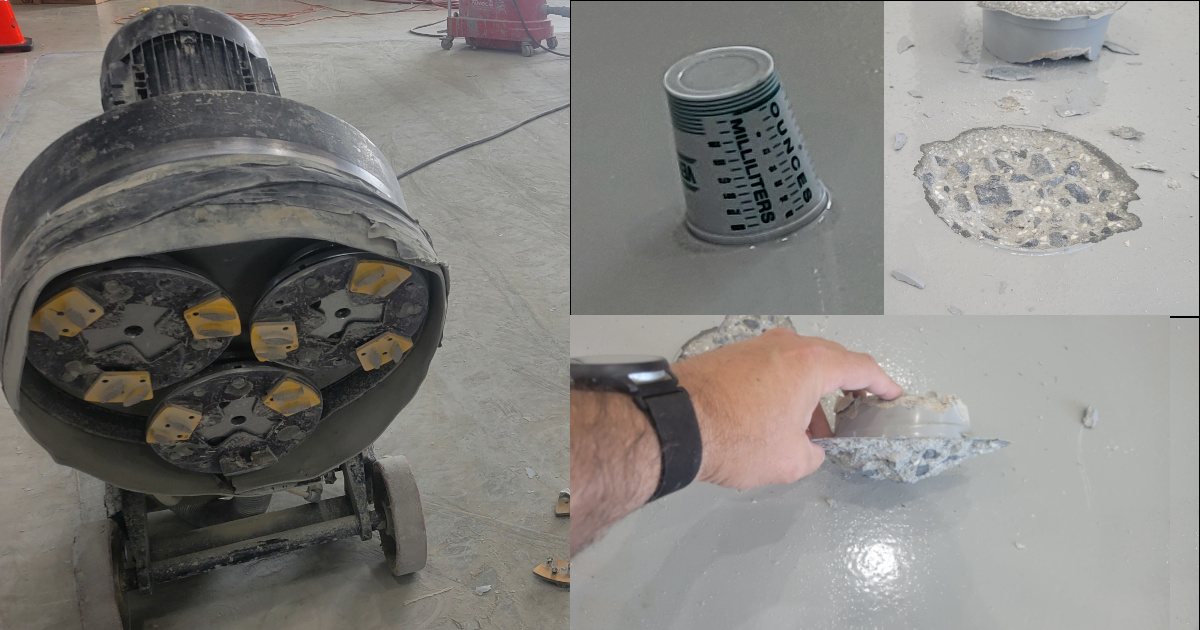
- We took our standard industrial epoxy and thickened it with a handful of sand to give it some viscosity so it wouldn't drain out.
- We poured this mixture into a standard red Solo cup.
- We flipped the cup upside down and bonded it directly to the wet layer of the epoxy base coat we had just applied to the prepped concrete (using a 25-grit diamond grind to a CSP-3, which is our standard concrete surface profile for garages; process used our standard planetary diamond grinders as well).
- We allowed the epoxy to fully cure and harden into a solid, rock-like structure.
- Once cured, we came back and hit the side of that cup structure very hard with a mini sledgehammer.
The goal of a pull test is to see where the failure occurs when extreme lateral or vertical force is applied. If the coating is bonded properly, it should not pop off the concrete—it should pull the concrete up with it.
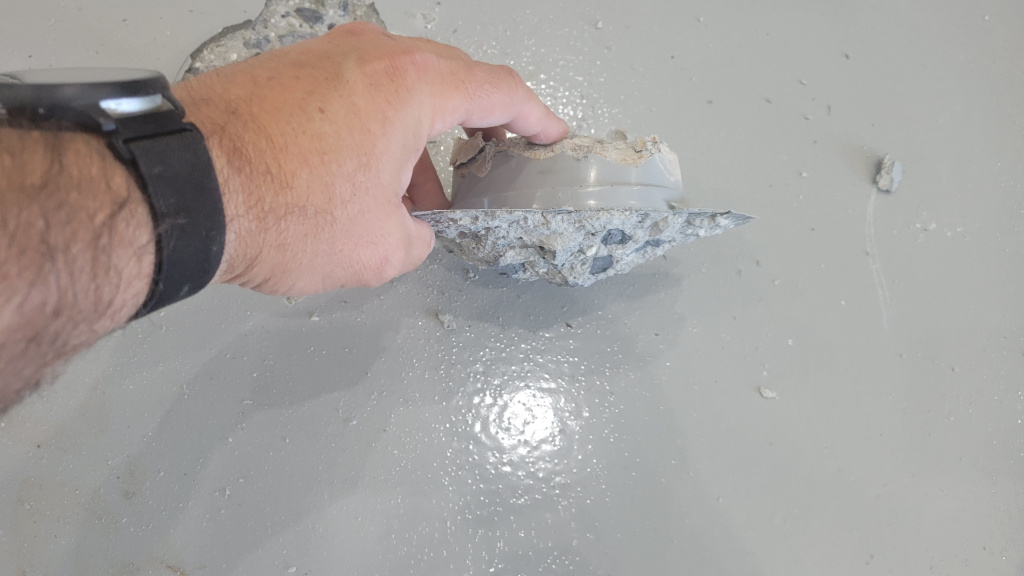
When we hit that cup with a hammer, it tore off at least 1/4 inch—and in some areas almost 1 inch deep—of the 5,000 PSI concrete underneath it. The concrete failed before the epoxy bond did. It pulled up the concrete in the entire radius of the cup!
Saying that epoxy doesn't bond well is completely false. It works exceptionally well as a bonding layer to the concrete. That exact 5,000-square-foot facility has since been fully coated in our epoxy system, where it serves daily to protect a heavy equipment shop floor.
The "Best of Both Worlds" Approach: Hybrid Systems
At Stronghold Floors, we refuse to compromise quality just so we can rush through an installation in a single day. We know that the companies rushing to get in and get out are the ones who will ultimately face the most issues with the coatings failing to stay bonded to the concrete (most likely as "hot tire peel").
Instead, we use a hybrid approach that leverages the strengths of both chemicals. Our company, and many other older franchises with extensive experience and historical data, are still using this exact method because it is the gold standard of the industry:
- The Base Coat (Industrial Epoxy): We use an industrial-grade epoxy for the foundational layer. Because epoxy sets slower, it has a longer "open window". This allows the liquid resin plenty of time to wick deep into the prepared concrete, creating both a mechanical anchor-like effect and a chemical cross-linking bond with the slab itself. We then broadcast our decorative flakes directly into this wet epoxy, locking them permanently into place.
- The Top Coat (Polyaspartic Polyurea): Once the epoxy has cured and locked onto the concrete, we return on day two to apply a high-quality polyaspartic clear coat. This gives you all the benefits that the marketers boast about: a water-clear finish that provides incredible UV stability, unmatched chemical resistance, and the flexibility needed to resist scratching.
We are using the best of both worlds: what epoxy is best at for the base coat, and what polyaspartic is best at for the top coat. We have an entire Podcast episode on Epoxy vs. Polyaspartic on YouTube which goes deeper into this subject - please check it out by clicking the PLAY button below.
-1.jpg)
Geographic Realities: Protecting Your Investment
Why does all this technical jargon matter to a homeowner in our service area? Because your garage floor faces a unique set of geographic challenges.
If you live anywhere from State College, PA down to Harrisburg, or across the Baltimore, MD suburbs, your garage floor is subjected to harsh winter weather. When you drive your vehicles inside during the winter, they bring in loads of snow, ice, and highly corrosive road salts.
Road salts aggressively attack bare concrete, breaking down the surface and leading to pitting, spalling, and a floor that is continually generating concrete dust. A proper floor coating is not just about aesthetics; it is about heavy-duty surface protection. It stops road salt damage in its tracks and keeps automotive fluids from permanently staining the porous concrete.
However, if you choose a "one-day" polyaspartic system that fails to bond deeply with the concrete, the first time you park a heavy vehicle with hot tires on that floor, the heat and pressure can cause that weak surface bond to fail, leading to hot tire peel. By utilizing a proper two-day system with an industrial epoxy base coat, we ensure your floor is locked down tight and ready to handle whatever the Mid-Atlantic winters throw at it.
Conclusion
Epoxies have their place. They have specific situations in the chemistry of coatings where they are not just appropriate, but they are the most appropriate choice.
The next time you see an advertisement badmouthing epoxy, remember the context. Are they talking about a cheap DIY paint kit, or a 75-year proven industrial resin? Are they a product expert educating you on chemical properties, or a franchise trying to sell you a rushed, one-day installation so they can get onto the next job?
At Stronghold Floors, our primary goal is to help you make an informed decision so you can avoid expensive mistakes. We believe in doing the job right the first time, using the proper materials for the proper layers, even if it takes an extra day.
If you are a discerning homeowner who values quality, longevity, and a company that stands behind its work, we would love to speak with you. Contact our team today to request a Free Quote and schedule a professional, on-site estimate. We will evaluate your concrete, answer your questions transparently, and design a floor coating system built to last.