


Why Does Concrete Crack in a Garage Floor?
Quick Answers:
-
Why does concrete crack? Shrinkage, settlement, and structural movement are common causes.
-
Can epoxy fill the cracks? Not directly. Cracks are prepped and filled with specialized repair materials before coating.
-
Will cracks reappear after coating? Possibly. Environmental and structural movement can cause cracks to re-emerge.
We’re often asked many questions by homeowners regarding our epoxy floor coatings. Some of the more commonly asked questions concern cracks in the concrete surface:
“Why is my concrete floor cracking?”
“Will STRONGHOLD FLOORS’ garage floor coatings hide them?”
In part one of this series on concrete cracking, we’ll cover frequently asked questions about cracks in the concrete surface. While most of these questions come from homeowners concerning their garage or basement floors, a fair amount of the following information is applicable to commercial environments as well.
If you’re looking for information regarding the different types of concrete joints, read part two of this series, What if I Have a Joint?
Why Did My Concrete Floor Develop Cracks?
Most garage or basement floors develop some form of cracks due to the nature of concrete. They may be so small as to go unnoticed or the cracks may be “hidden” within the control joints (more on this in Part Two). Concrete naturally cracks over time, and these cracks vary by type and severity. Most garage or basement cracks fall into the following categories:
Shrinkage Cracks
These cracks are the most common and develop as the concrete slab cures. The curing process decreases the volume of the concrete mass due to the evaporation of water content and forces the concrete to develop cracks in the weaker parts of its construct.

These occur as the concrete cures and shrinks in volume. Common types include:
Drying Shrinkage
Drying shrinkage typically causes a jagged crack that occurs in a 3-point pattern, such as in the image on the right.
Map Cracking (Plastic Shrinkage)
Shallow, spider-web-like surface cracks with minimal depth. Map cracking (also known as plastic shrinkage) creates a spider-web looking random pattern on the surface and the cracks often have very little depth.

Plastic Settlement Cracking
Plastic settlement cracking causes discreet, parallel cracks that appear to tear the surface. They usually appear while the concrete is fresh. The cracks often reflect the location of the slab's reinforcement (from rebar, wire mesh, I-beams, or footers).

Settlement Cracks
Settlement cracks result as a structural failure where elevation changes have caused one side of the crack to be lower than the other. These cracks are often called “moving cracks” as the cracks completely traverse through the slab and allow each piece to move independent of the other.
Note: While shrinkage cracks are typical and are expected to some degree (dependent upon the slabs make-up and placement), true settlement cracks may be more serious and need to be evaluated in greater detail to determine if the cracking will continue.

Do the epoxy coatings fill in the cracks?
Not by themselves. We don’t rely on epoxy or polyaspartic coatings to hide or fill cracks. Here’s what we do instead:
-
Crack-Chasing: We cut open cracks to remove loose materials and create clean, bondable surfaces.
-
Vacuum Cleaning: All debris and dust is removed.
-
Crack Filling: We use fast- or slow-setting epoxies or polyureas depending on depth, width, surface conditions, and floor temperature.
-
Curing: Depending on material used, some repairs cure in minutes, others overnight.
In cases of moving cracks, we may recommend involving other professionals to assess and stabilize the slab before proceeding with repairs.

Depending on the severity of the cracks in your floor, we may need an additional day to prepare the concrete before applying the base coat. A skim coat was used in this image to prepare the floor.
The crack repair materials used can vary, depending upon the width and depth of the cracks, as well as floor temperature, surface condition, and porosity of the concrete slab. The materials could be quick-set 2-part epoxy crack fillers designed to be coated over immediately or fast setting polyurea. Or, they may be slow setting, thixotropic (thickened) epoxies or hybrid polymers that fill wider or deeper cracks and setup over a period of hours or days.
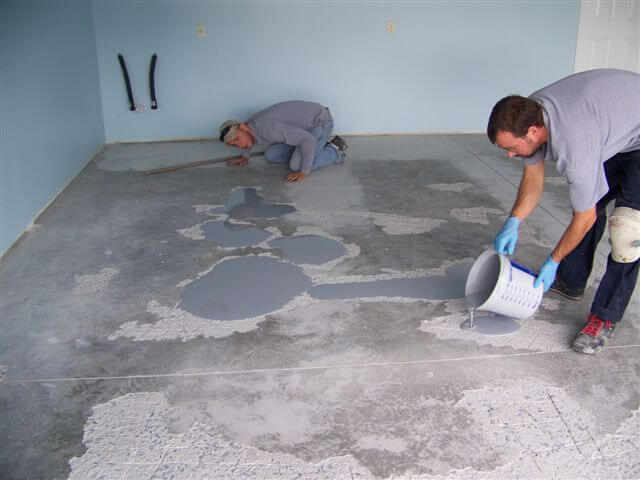
Slow setting epoxies being applied to cracks. The next day, once the epoxy cures, the floor will be prepared with diamond grinders.
What if the cracks are filled with silicone caulk?
Our installation teams will remove any caulk from cracks during the surface preparation process and refill with the appropriate polymer repair materials.
 Will the cracks return through the coatings?
Unfortunately, the answer is “maybe”. The return of the original crack or formation of new cracks that show through the coating may reappear due to:
-
Slab vibration or expansion/contraction
-
Hydrostatic vapor pressure
-
Ongoing settlement or structural issues
Anyone who guarantees that cracks will never return through an epoxy coating is overpromising.
With my experience in this business, I can tell you that the reappearance of cracks through garage floor coatings is not common for Pennsylvania, Maryland, and Virginia. In addition, using a coating such as decorative chips decreases the likelihood that a very small, tight crack would be easily visible in the coatings.
Example: My own garage floor has a crack in the coating that appeared about four years after it was installed, but I only noticed it after getting down on my knees to remove some road tar. I never bothered to fix it, as the fix would be more noticeable than the crack and its presence poses no issues for the coatings' performance.
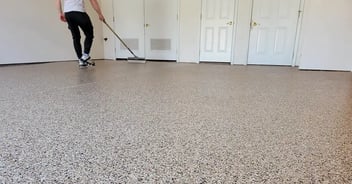
Decorative chip coatings help disguise minor hairline cracks if they do occur.
Why Do My Cracks Have a White Plastic Strip?
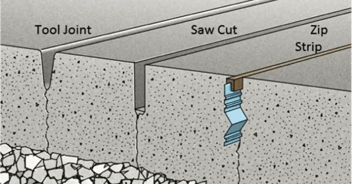
Those cracks are actually a type of control joint (which is discussed in part two of this article, linked below) and the white plastic is what’s referred to as a zip strip (also known as a point of weakness or POW strip). These are very common in garage and basement slab construction.
For more information on the different types of concrete joints, continue reading part two of this blog post, What if I Have a Joint?
Mike Mincemoyer has over 20 years of experience with the design and execution of repairs to concrete slabs. His installation teams have helped thousands of homeowners with the surface preparation, crack repairs, and coatings installations required to give them a beautiful garage and basement floor.